Hardware & Sensors
Learn about the built-in sensors and other hardware components.
Air Sensors
Air Lab measures six parameters: CO₂ (carbon dioxide), VOCs (volatile organic compounds), NOx (nitric oxide and nitrogen dioxide), temperature, humidity, and atmospheric pressure. Three sensors work together to continuously capture this data.
All sensors are located at the top rim, behind the logo on the front face. This area is thermally insulated from the rest of the board, preventing heat from other components from affecting readings.
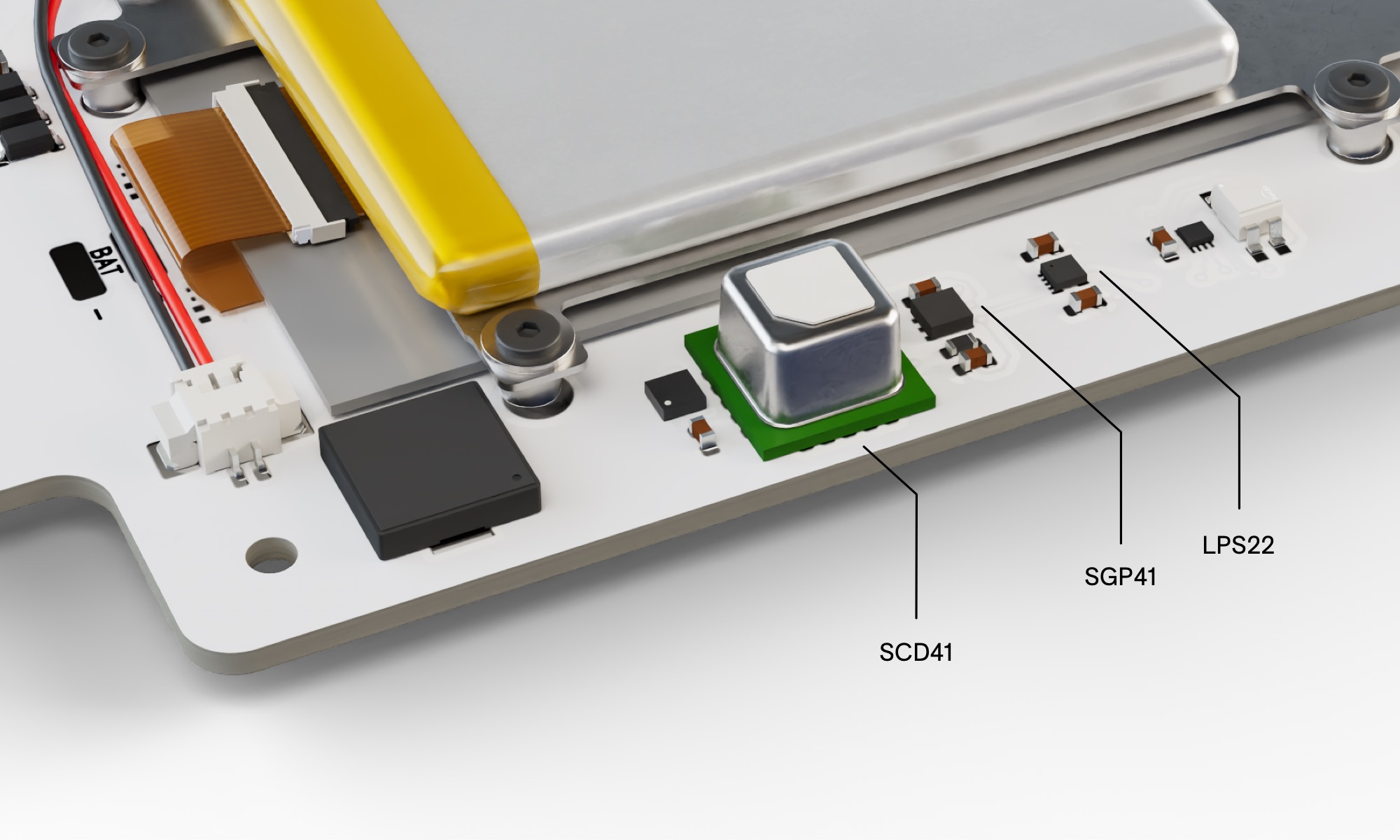
The following sensors measure the various aspects of air quality:
- SCD41: Measures CO₂ concentration, temperature, and relative humidity.
- SGP41: Detects volatile organic compounds (VOCs) and nitrogen oxides (NOx).
- LPS22: Measures barometric pressure.
Tip: If you want to know more about the differences between CO₂ sensor technologies, check out this blog post that does an excellent job in comparing them.
Carbon dioxide is a primary air quality indicator as it's useful in most indoor environments. The SCD41 sensor uses photoacoustic NDIR (Non-Dispersive Infrared) technology to measure CO₂, which offers excellent long-term stability, is immune to environmental contaminants, and maintains high accuracy without requiring frequent recalibration (exposure to outdoor air).
The SGP41 sensor detects important and highly damaging air pollutants that should be avoided. The sensing technology used doesn't provide absolute readings, but instead an indexed value that correlates with changes in pollutant detection.
The LPS22 sensor supports correlating air quality with weather changes. This is useful for environments with strong air pollution that affects indoor spaces differently depending on the weather.
Controller & Power
Air Lab runs on an ESP32-S3 microcontroller, chosen for its widespread use in the maker community. This makes writing custom firmware accessible to anyone familiar with embedded development, as well as people getting started.
The ESP32-S3-WROOM-1-N16R8 module includes 8 MB of PSRAM for graphics and 16 MB of flash storage for firmware, recordings, and other files.
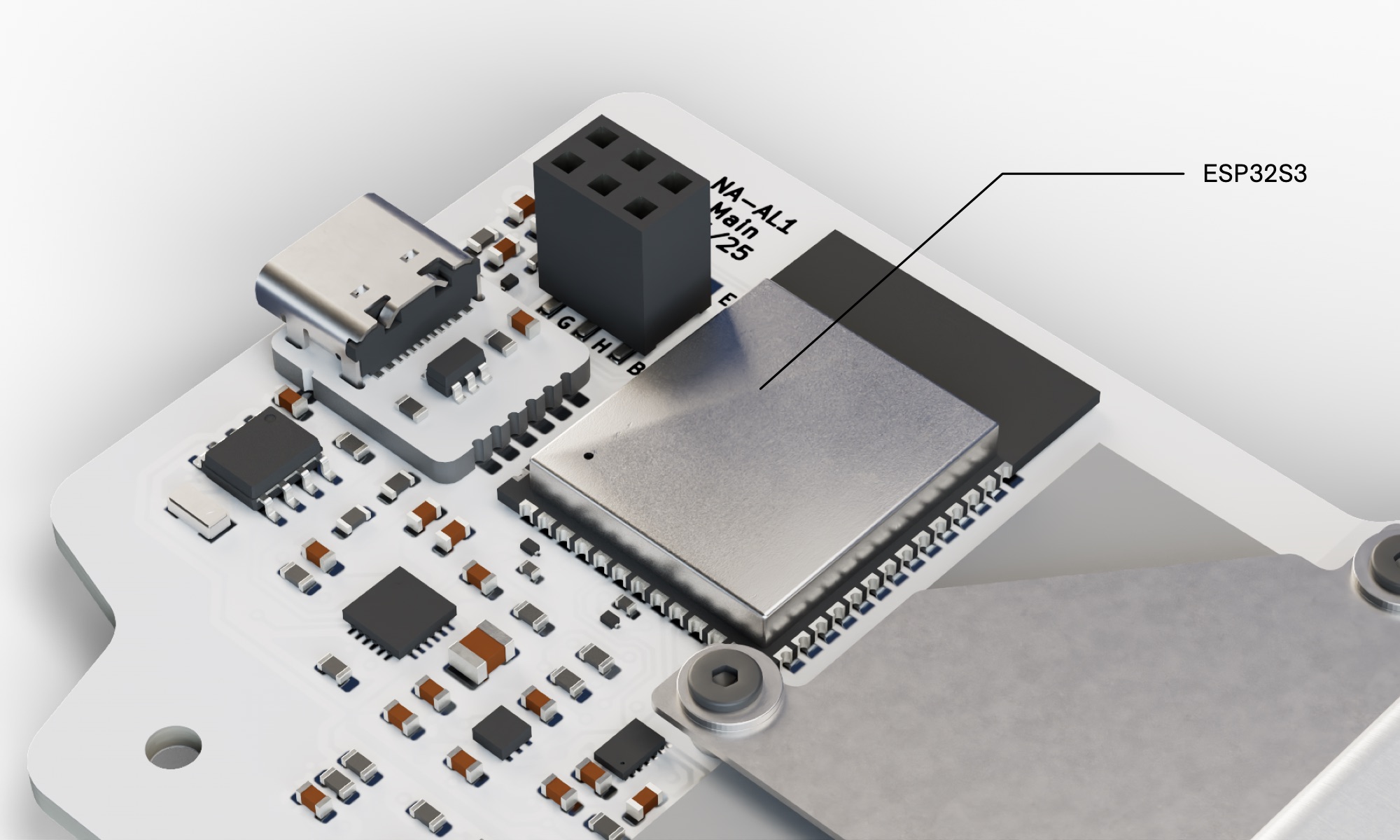
The following supporting ICs work alongside the microcontroller:
- BQ32000: A real-time clock for accurate timekeeping and scheduling, operating at ultra-low power with battery backup.
- FXLS8974CF: A low-power 3-axis accelerometer for motion detection and orientation sensing, with 14-bit resolution.
- BQ25601: A high-efficiency battery charging IC with power path management and USB input current limiting.
- STM6601: A power supervisor and on/off controller with debounced button input and programmable timing.
Human Interface
Air Lab uses an E-Paper display, buttons, a touch-sensitive scroll bar, an LED indicator, and a buzzer to communicate with you.
The 2.9" E-Paper display is ideal for showing information that updates periodically. It supports partial updates, enabling smooth animations despite the technology's inherent latency. The display uses a standard size, making replacement straightforward if ever needed.
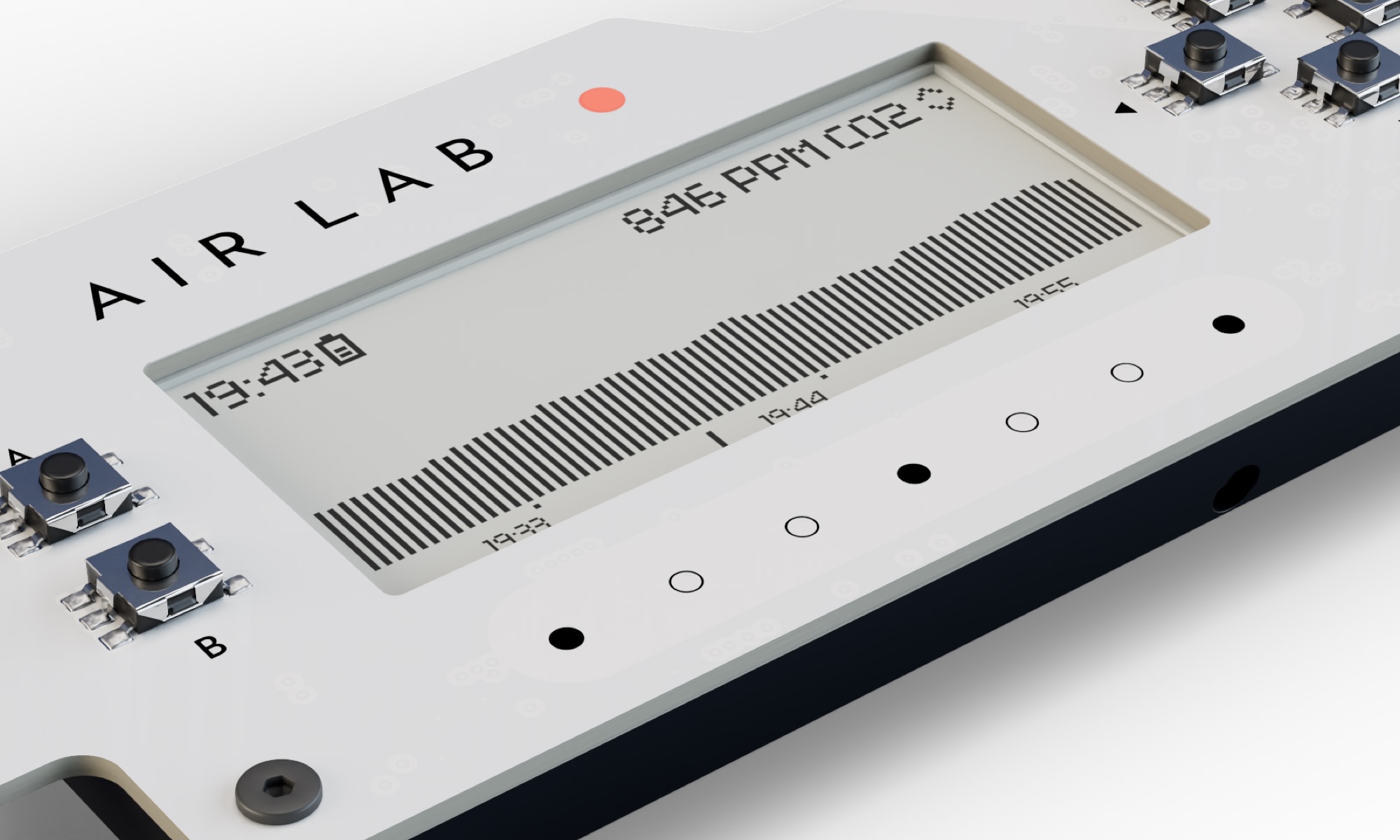
The six buttons are arranged in a D-pad layout with two action buttons—similar to retro game controllers. The capacitive scroll bar has seven touchpoints, measured by a CY8CMBR3108 controller that provides responsive, power-efficient touch sensing.
A piezo buzzer provides audio feedback. It clicks when you interact with the scroll bar and can emit tones for alerts and notifications.
Back to Top